

Most UGC briefs don’t fail because of bad ideas. They fail because they’re either too vague or too restrictive. When creators don’t have enough direction, they guess. When they have too many rules, the content starts to feel forced.
And when that happens, performance suffers.
A good brief does the opposite. It gives creators a clear direction while still leaving room for their own style. It sets expectations without turning the content into a script.
Here’s how to do it right.
Why Most UGC Briefs Fail
Most UGC briefs don’t fail because of bad intentions. They fail because they miss the balance between clarity and flexibility.
Some are too vague. Creators are told to “be creative,” but without clear direction, they’re left guessing what the brand actually wants.
Others go too far in the opposite direction. Every line is scripted, every shot is controlled, and the final result feels unnatural, more like an ad than real content.
And sometimes, there’s no real context at all. Creators don’t understand the product, the audience, or the goal behind the campaign. So even if the content looks good, it doesn’t perform.
The goal isn’t more instructions. It’s better direction.
The Perfect UGC Brief (Simple Structure)
A good UGC brief doesn’t need to be long or complicated. In fact, the best ones are simple, clear, and easy to scan. If a creator can read it in a couple of minutes and immediately understand what to do, you’re on the right track.
Here’s the structure that works.
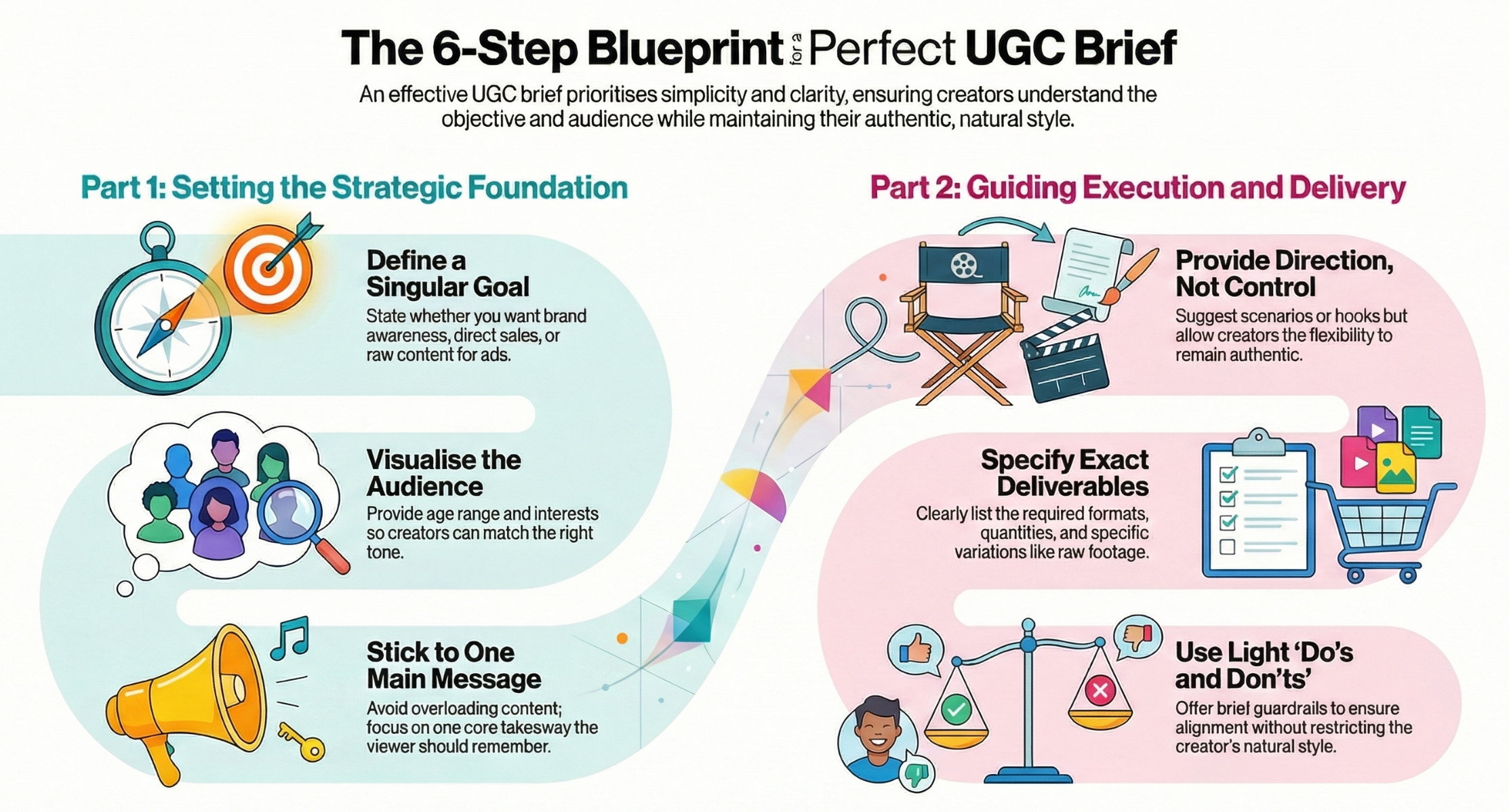
1. Goal
Start with the outcome. Before a creator films anything, they should understand what this piece of content is supposed to do.
Are you trying to introduce your brand to new people? Get more clicks or sales? Collect raw UGC you can reuse later in ads, on product pages, or on social media? These are very different goals, and each one leads to a different type of content.
For example, a brand awareness video might focus on lifestyle, first impressions, or the overall vibe of the product. A conversion-focused video usually needs a stronger hook, clearer product benefits, and a reason to take action. And if your goal is to build a content library, you may care more about variety, natural product shots, and multiple use cases than direct selling. If you're running UGC ads on Meta or TikTok, knowing the goal upfront also shapes how creators approach the hook and CTA.
This is why the goal needs to be stated clearly in the brief. If the creator does not know the purpose of the content, they have to guess. And when they guess, the content may look fine on the surface but still miss the mark.
Keep this section simple and specific. One or two clear sentences are enough. The creator should be able to read it and immediately understand what success looks like. If the goal isn’t clear, everything else in the brief becomes harder to execute.
2. Audience
Once the goal is clear, the next step is the audience. Who is this content actually for?
Creators do better work when they can picture the person on the other side of the screen. They need to know who they’re talking to, what kind of lifestyle that person has, and what would make the content feel relevant to them. Without that context, the video may still look good, but it can end up feeling too broad or disconnected.
You do not need to build out a full customer persona here. In most cases, a few simple details are enough. Think about the age range, the person’s interests, and the general mindset they have. Are they students, busy parents, skincare beginners, fitness-focused men, or people trying to simplify their routine? That kind of information helps creators shape the tone, examples, and style of the content.
It also helps them choose the right language. The way someone speaks to Gen Z is different from how they speak to a professional audience in their 30s or 40s. The pacing, references, and overall energy can change a lot depending on who the content is meant to reach.
The better a creator understands the audience, the more natural the content will feel. And when content feels natural, it usually performs better too.
3. Key Message
Every piece of content should have one main takeaway. Before the creator starts filming, they should know exactly what you want the viewer to remember once the video ends.
This is where a lot of briefs become messy. Brands often try to fit too much into one piece of content. They want the creator to mention the product features, the founder story, the discount, the shipping, the social proof, and the brand mission all at once. The result is usually content that feels overloaded and unclear.
A better approach is to choose one main idea and build around that. It could be something simple like “this product saves time,” “this makes everyday life easier,” or “this is a better option for sensitive skin.” Whatever it is, keep it focused. If you're not sure how to structure that message for different video formats, these UGC script templates for five ad types are a useful reference.
That does not mean other details cannot appear naturally in the video. It just means there should be one core message guiding the content. When the message is clear, creators know what to emphasize, how to shape the story, and what kind of tone makes the most sense.
The clearer the message, the easier the execution becomes. And in most cases, simpler content is the content people actually remember.
4. Content Direction
This is the part where many brands overdo it. They try to control every word, every shot, and every transition, hoping that more detail will lead to better content. In reality, it often does the opposite.
UGC works because it feels natural. The moment it starts sounding too polished or too scripted, it loses the thing that makes it effective in the first place.
That’s why this section of the brief should focus on direction, not control. Instead of writing the exact script, give creators a clear sense of where the content should go. You can suggest possible hooks, a few angles to explore, or simple scenarios that make sense for the product. For example, you might suggest a “first impression” style video, a daily routine use case, or a problem-and-solution format. For more on how to structure this part, it's worth seeing what works in practice.
This gives the creator enough structure to understand your expectations, while still leaving room for their own style, voice, and instincts. And that part matters. Most creators know how to speak to their audience better than the brand does. If you remove that flexibility, the content can start to feel stiff and unnatural.
The goal here is to guide the creator, not to turn them into a spokesperson reading lines. When creators have room to interpret the brief in their own way, the final content usually feels more authentic, and performs better because of it.
5. Deliverables
This part should leave no room for guesswork. Be clear about what you need the creator to send, in what format, and how many versions you expect.
For example, are you asking for one TikTok video, one Instagram Reel, and two hook variations? Do you want raw footage too, or just the final edited version? Should the content be filmed vertically? Do you need subtitles, voiceover, product close-ups, or both talking-to-camera and b-roll?
These details may seem small, but they make a big difference. When deliverables are unclear, creators may submit something that technically looks good but does not match what the brand had in mind. That usually leads to revisions, extra messages, and wasted time on both sides.
A clear deliverables section makes the process smoother from the start. The creator knows exactly what they are responsible for, and the brand knows what to expect at the end. It also helps avoid awkward conversations later, especially when deadlines are involved.
The simpler and more specific you are here, the better. Clarity saves time, reduces back-and-forth, and makes the collaboration feel more professional for everyone involved. If you're managing multiple campaigns at once, Clip's campaign tools let you handle briefs, revisions, and approvals all in one place.
6. Do’s & Don’ts
A simple do’s and don’ts section can be very helpful, but it should stay light. This is not the place to overwhelm creators with a long list of rules. It is just there to give a bit of extra guidance and help them understand what kind of content the brand wants to see.
For example, you might encourage them to speak naturally, show the product in a real-life setting, or keep the tone casual and honest. On the other side, you might ask them not to over-edit the video, not to make it feel too polished, or not to sound like they are reading from a script.
This section works best when it supports the creative process instead of limiting it. Think of it as a way to point creators in the right direction, not a way to control every detail. A few clear reminders are usually enough.
When handled well, do’s and don’ts can improve the final content without making the brief feel restrictive. The goal is to create alignment, not pressure.
Quick Example
Here’s what a simple UGC brief can look like in practice:
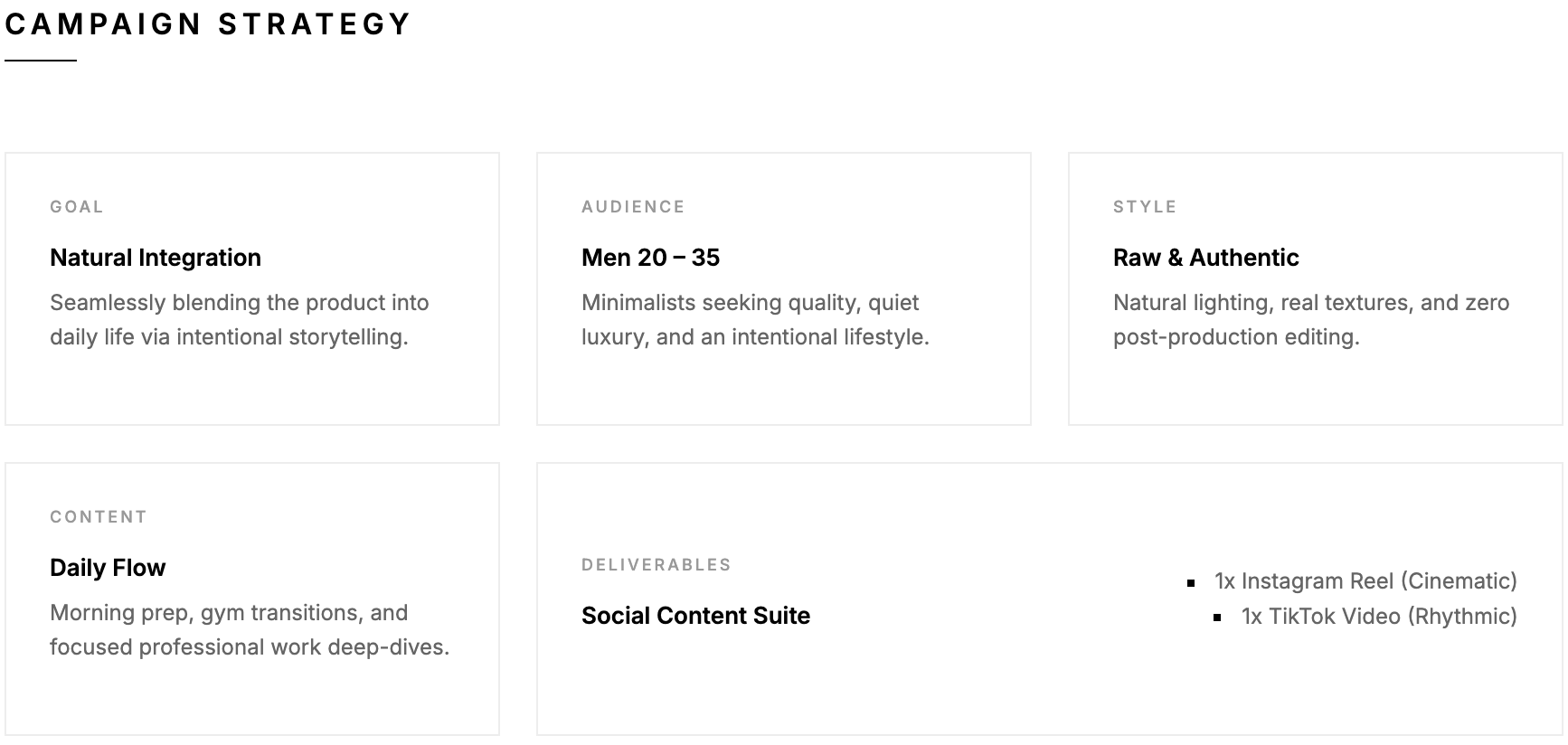
It doesn’t need to be more complicated than that. A short, clear brief like this gives the creator enough direction to understand the goal, while still leaving room for their own personality and style.
3 Tips Creators Actually Care About
If you want creators to enjoy working with your brand, the brief matters just as much as the product. A few small things can make a big difference.
First, keep it short. Most creators do not want to dig through a long document just to understand what you need. If the brief is clear, one or two pages is usually enough. The easier it is to read, the easier it is to execute.
Second, speak like a human. A brief should feel clear and natural, not like it was written by a legal team or filled with brand jargon. The more direct and normal your language is, the easier it is for creators to understand the tone and intent behind the campaign. Our podcast episode on UGC briefs covers exactly this, including what creators themselves say they want to see.
And finally, trust the creator's style. You chose them for a reason. They already know how to create content that feels natural to their audience. If you try to control every detail, the final result can lose that authenticity. A good brief gives structure, but it still leaves room for the creator to do what they do best. It also helps to work with creators who are already trained to interpret briefs well, that alone removes a lot of the back-and-forth.
Final Thought
The best UGC briefs do not control creators. They guide them.
When the direction is clear and the brief leaves room for creativity, the content usually feels more natural, more relatable, and more effective. That is what good UGC is supposed to do.
Looking for vetted UGC creators who already understand how to make content like this? Clip makes it easy to find them, brief them, and get content that performs.
Table of contents