Thousands of views. Zero sales. Here’s why.
You launch an influencer campaign and everything looks right. The creator fits your brand. The video is clean. The delivery feels natural. Comments start rolling in, likes stack up, and for a moment it feels like the post is doing its job.
Then you check the numbers that actually matter.
Your website traffic barely moves.
Or you get a spike… and it disappears as fast as it came.
Or people click through… and nothing happens. No sign-ups. No purchases. No real lift.
That’s the frustrating part: on the surface, it worked. The post “performed.” It got attention, engagement, maybe even a decent view count.
But performance isn’t conversion.
And most influencer campaigns don’t fail because your product is bad or your creator was “wrong.” They fail for one simple reason:
they don’t earn attention long enough to make someone care, let alone buy.
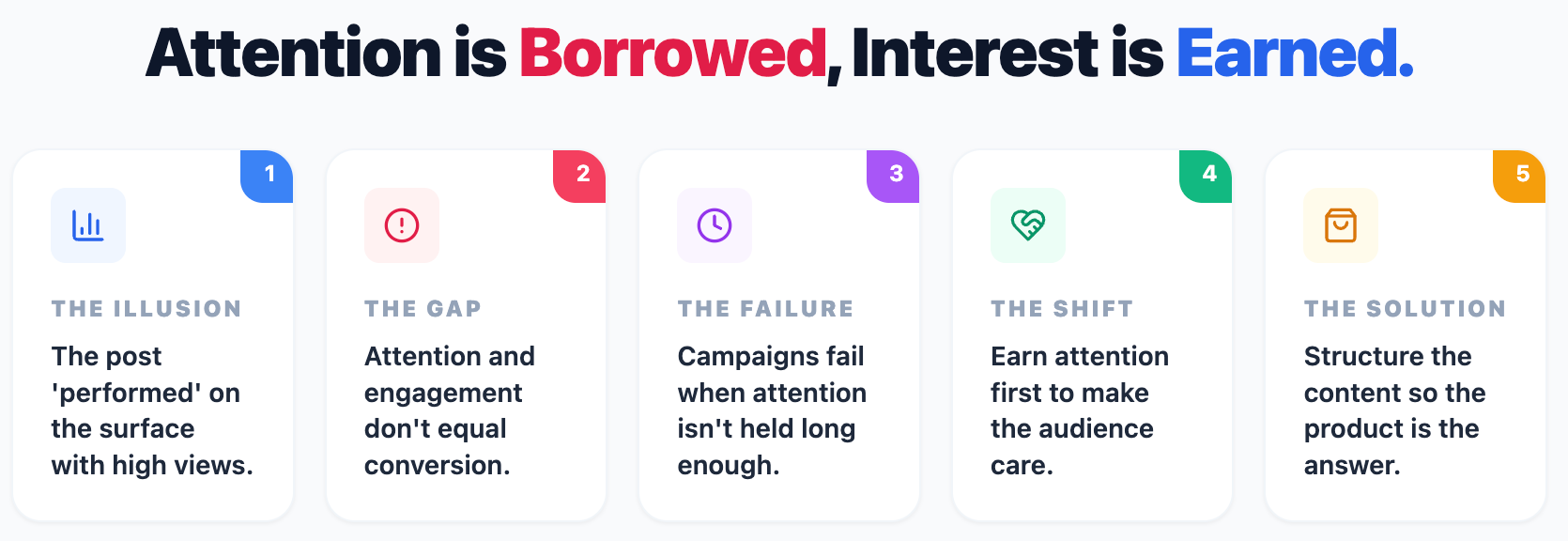
The real problem: influencers sell exposure, not action
Influencer marketing has a dirty little truth: most creators are trained to entertain, not convert.
They’re great at making content that looks right:
- they sound natural on camera
- they know how to film something aesthetically pleasing
- they can keep things “safe” and brand-friendly
And that’s exactly the issue.
Because conversion content isn’t safe. It’s not trying to be cute or polished. It’s trying to get a reaction.
Conversion content has one job:
interrupt autopilot and push someone toward a decision.
Your audience isn’t sitting down to watch your video like it’s a YouTube documentary. They’re scrolling while waiting in line, half-distracted, killing time between tasks.
Fast.
On autopilot.
No judgment. No deep thought. Just thumb movement.
So if your content doesn’t interrupt that autopilot immediately, the viewer never reaches the part where you “explain the product.”
They never even get far enough to care.
The hook is the bottleneck (the stop-scroll moment)
A hook isn’t “the first 3–5 seconds.”
A hook is the moment that stops the scroll long enough for someone to give you a chance.
And if the hook doesn’t hook, the rest of the video doesn’t exist.
Not because your offer is bad.
Not because your product is weak.
Because they never even got far enough to find out.
This is why you can work with “good creators” and still get campaigns that don’t convert. The content can be clean, on-brand, and well-shot… and still fail.
Because they’re posting content.
They’re not building stop-scroll moments.
Warm-up intros
The fastest way to kill an influencer ad is to start like you’re asking for permission.
“Hi guys…”
“So today I’m gonna show you…”
“I wanted to talk about…”
Those lines feel harmless, but they do two things instantly:
They signal “this will take time”
The viewer hears a setup coming. Their brain goes: cool, not right now.
And their thumb keeps moving.
They feel like creator-content, not decision-content
Warm-ups belong in vlogs. In performance content, they’re dead weight. The viewer didn’t opt in. You’re interrupting them mid-scroll. If you don’t give them a reason to stay immediately, they won’t.
Because people aren’t waiting. You’re competing with infinite content—plus whatever mood they’re in, plus whatever distracted them five seconds ago.
So the rule is simple:
Don’t introduce the video. Enter the moment.
Start inside the situation the viewer recognizes.
- “I almost returned this… until I tried it like this.”
- “If your influencer campaigns get likes but no sales, this is why.”
- “I used to hate doing this every morning.”
- “This is the part nobody tells you about ___.”
No warm-up. No greeting. No “today we’re talking about.”
Just the moment that makes someone stop and think: wait… what?
Product-first
Most influencer scripts start like a website.
“This is [product].”
“It has [features].”
“Today I’m gonna show you how it works…”
It sounds logical. It’s also why people scroll.
Because in the first second, the viewer is asking one thing:
“Why should I care?”
And “here’s the product” doesn’t answer that. It’s a label, not a reason. Features don’t create attention when the viewer hasn’t felt the problem yet.
Why product-first fails
1) It feels like an ad immediately.
The moment you lead with the product name, the viewer’s guard goes up. They’ve seen the pattern a thousand times: brand intro → features → discount code. Scroll.
2) Features have no meaning without context.
“12-hour battery” means nothing until you connect it to a real annoyance: “I stopped charging this twice a day.”
3) You’re skipping the emotional entry point.
People don’t stop scrolling because of specs. They stop because they recognize themselves in a moment.
The fix: flip the order
Context first. Product second. Explanation third.
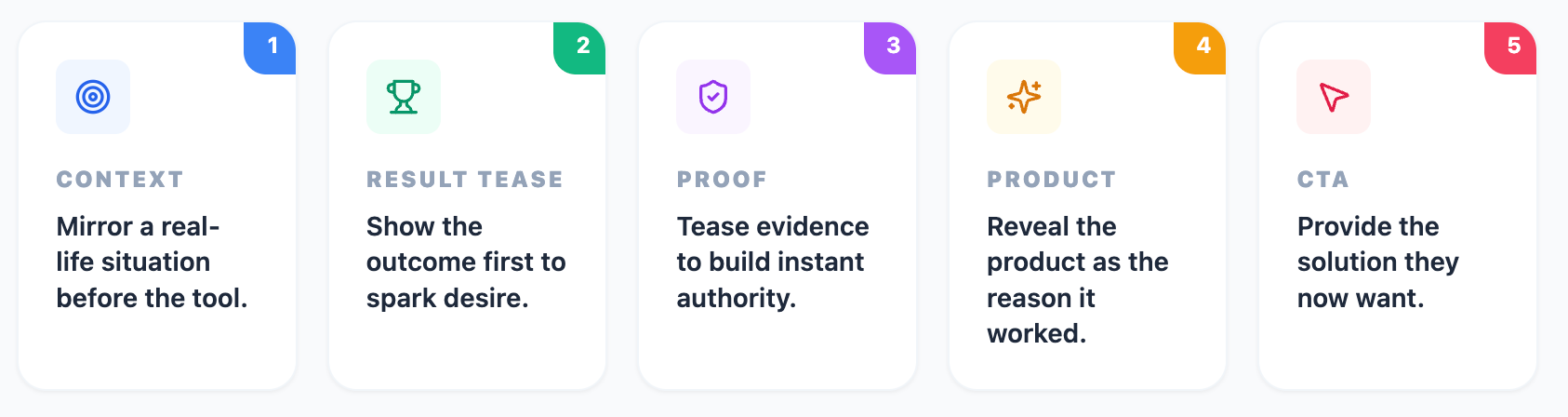
Start with the real-life situation before you reveal the tool.
- “My mornings were chaos until I fixed this one step.”
- “If you keep wasting money on creators, it’s usually because of this.”
- “I thought this was a gimmick… then I saw the result.”
- “Here’s what annoyed me every day—and what finally solved it.”
Then you show the outcome, tease the proof, and only then bring in the product as the reason it worked.
Because once the viewer feels the problem, the product stops being “an ad”…
and becomes the solution they were already looking for.
No result shown early
Creators love building suspense.
They want to “set the scene,” walk through the process, and reveal the payoff at the end like it’s a YouTube tutorial.
But suspense is a luxury you don’t have on Shorts, Reels, or TikTok.
Because the viewer isn’t sitting there thinking, “I wonder what happens.”
They’re thinking, “Is this worth my attention?”
And they decide that in a blink.
If the result shows up at second 40, you lost them at second 2.
Why this kills conversions
1) People don’t wait for the payoff.
They don’t owe you attention. They’re not “along for the journey.” They’re scanning for something that feels immediately relevant.
2) The “proof” is the reason they stay.
The outcome is what creates curiosity. Without it, your video is just… talking.
3) Early proof lowers skepticism.
When viewers see a real result upfront, the rest of the story feels like an explanation, not a pitch.
What to do instead: show the outcome first
Lead with what the viewer actually wants:
- the transformed hair
- the clear skin
- the before/after
- the time saved
- the solved annoyance
- the “I can’t believe this worked” moment
Then rewind and explain what caused it.
This is the order:
Outcome → Context → How it happened → Product → CTA
Quick example (same content, better sequence)
Bad: “Let me show you my routine… step 1… step 2…” (result at the end)
Better: “This is the first time my hair looked like this in 5 minutes… here’s what I did.”
You’re not spoiling the video by showing the result early.
You’re earning the right to explain it.
Feature dumping
Feature dumping is what happens when a creator sounds like they’re reading your landing page out loud.
“It has 12-hour battery.”
“It’s made from premium materials.”
“It has three modes.”
“It’s 4K.”
“It’s dermatologist-tested.”
None of those are bad, they’re just useless in the first few seconds.
Because features don’t convert. Relatable problems convert.
Why features don’t hook
1) Features are abstract.
They don’t mean anything until the viewer connects them to a moment in their life.
“12-hour battery” = okay.
“Stopped charging this thing twice a day” = oh, that’s me.
2) Features feel like selling.
The viewer can smell a pitch. Feature lists trigger “ad brain” and they scroll.
3) Features don’t create emotion.
Conversion starts with emotion, frustration, relief, curiosity, hope. Features rarely trigger any of that on their own.
The fix: translate every feature into a lived benefit
A simple rule that changes everything:
Feature → frustration it removes → relief it creates
- “12-hour battery” → “I stopped carrying a charger everywhere.”
- “Waterproof” → “I can finally stop babying it.”
- “Fast shipping” → “I needed it this week and it actually showed up.”
- “One-click setup” → “I didn’t waste an hour figuring it out.”

Now the viewer isn’t hearing specs. They’re hearing a story they recognize.
Because people don’t buy specs.
They buy relief.
No real-life moment
The best converting UGC doesn’t feel like an ad. It feels like real life.
Not “here’s a product review.” Not “let me tell you about this brand.” More like you just dropped into someone’s day at the exact moment the problem shows up.
That’s what makes people stop. They’re not listening to a pitch. They’re recognizing a situation.
A real-life moment looks like rushing before work while everything goes wrong. It looks like trying to get kids out the door and losing patience. It looks like the same annoying issue happening again and again until you hit that “I’m done” point. Or it looks like that rare moment where you try something with low expectations… and it actually works.
Those moments create emotion, frustration, relief, curiosity, recognition. And emotion is what earns attention.
If there’s no moment, there’s no entry point. Without an entry point, the viewer never feels the problem. And if they don’t feel the problem, the solution doesn’t matter.
The fix is simple: start inside the scene. Start with the situation, the tension, the irritation, the “this is my life” moment, then reveal the product as the reason the moment changes.
Fix: the hook-first structure (the order that converts)
If you want creator content to convert, you need a structure that earns attention first and sells second. The simplest one that keeps working—across niches, creators, and platforms, is this:
Context → Result tease → Proof → Product → CTA
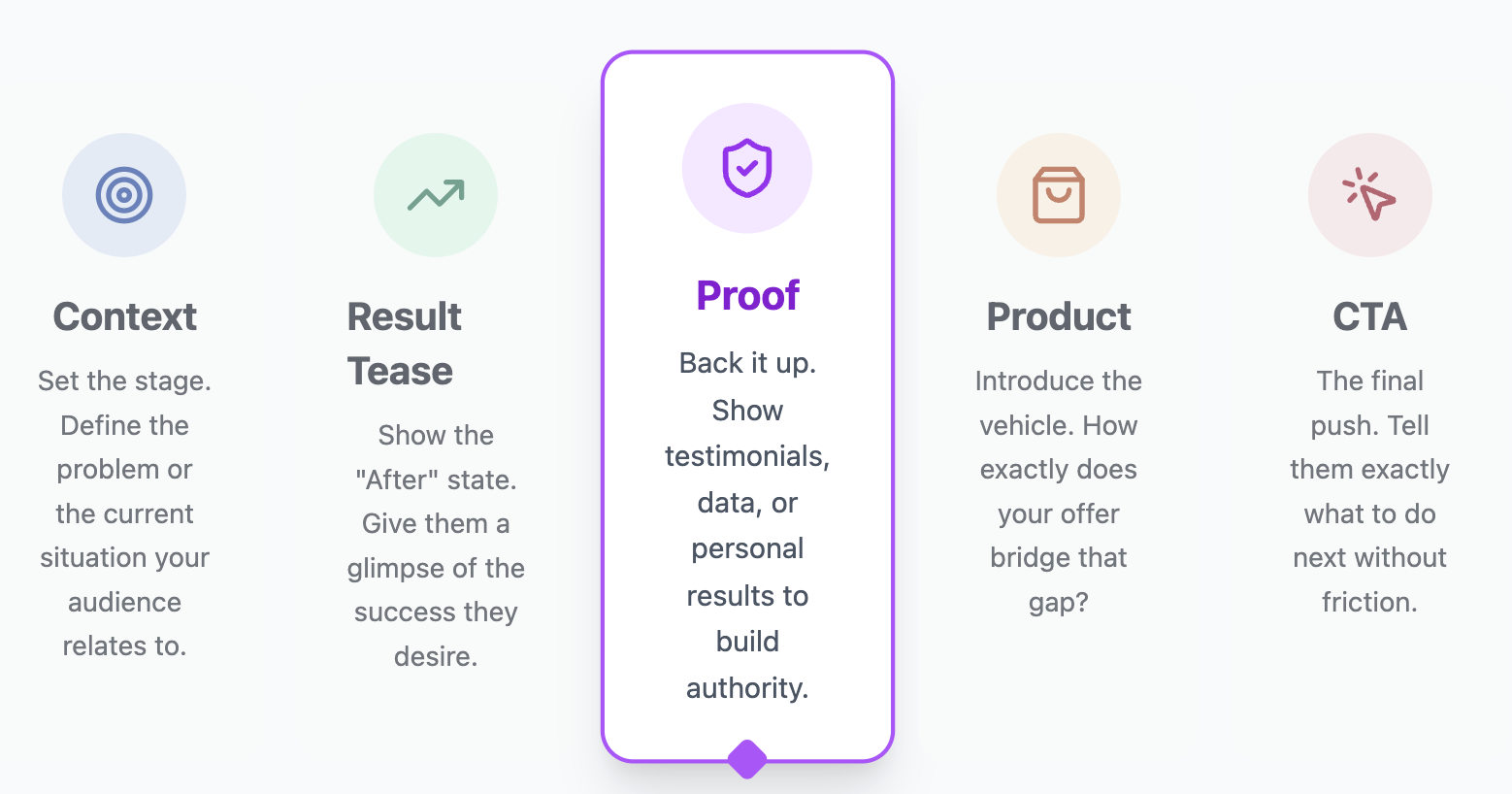
Start with context so the viewer instantly knows, “this is about my life.” Not the product name. Not the brand story. The situation.
“Mornings are chaos and my kid refuses tablets.”
Then tease the result. Give them the payoff early so they have a reason to stay.
“This is the first time we didn’t fight.”
Next comes proof. Not claims. Not “trust me.” Proof means you show the moment, show the outcome, or show a clear before/after so the viewer’s brain registers: okay, something changed.
Only after that do you introduce the product, because now it’s not an ad, it’s an explanation. You’re simply answering the question the viewer is already asking: how did you do that?
Finally, you close with one clear next step. Not three. Not a paragraph. One action that matches the intent of the video.
This is why the hook-first structure converts: it doesn’t start by asking for attention. It starts by earning it. Then it uses that attention to sell.
Examples: rewriting bad hooks into good hooks
Here are 12 rewrites you can drop into the article now.
1
Bad: “Today I’m partnering with…”
Good: “If your influencer posts get likes but no sales, watch this.”
2
Bad: “Let me show you this product”
Good: “I wasted money on creators until I fixed THIS one thing.”
3
Bad: “This brand sent me…”
Good: “Stop paying for ‘exposure’ if you want conversions.”
4
Bad: “This is an amazing tool for…”
Good: “This fixed the most annoying part of my day.”
5
Bad: “Here are the features”
Good: “If you deal with ___ every day, you’ll get this instantly.”
6
Bad: “So I’ve been using this for a week…”
Good: “I didn’t expect this to work… but here’s what happened.”
7
Bad: “It’s super easy to use”
Good: “I used to hate doing ___ until I found this.”
8
Bad: “Use my code for…”
Good: “POV: you’re trying to ___ and it’s always a mess.”
9
Bad: “This is perfect for anyone who…”
Good: “This is why your ___ isn’t working (and how to fix it).”
10
Bad: “Here’s why I love it”
Good: “3 things I’d never buy again… except this one.”
11
Bad: “It comes in these colors…”
Good: “Here’s the fastest way to ___ without ___.”
12
Bad: “Don’t forget to like and follow”
Good: “Before you scroll—this one change doubled conversions.”
Most brands aren’t failing because they picked the “wrong influencer.” They’re failing because they’re paying for content that was never designed to convert in the first place.
Clip fixes that in two ways.
First, Clip creators are trained for performance hooks. They don’t open with “hey guys” or a soft intro. They start with the moment—the real-life situation the viewer instantly recognizes. They know how to trigger problem recognition without overexplaining it, build a little emotional tension that keeps the viewer watching, tease proof early instead of saving it for the end, keep pacing tight, and land a clean call-to-action without turning the video into a sales pitch.
Second, Clip is built for iteration, not one-offs. One good hook isn’t something you post once and move on from. It’s something you scale. Clip makes it easy to run the same hook with different creators, adapt it for new markets, change the first line without breaking the structure, and test new visuals while keeping the winning angle intact. That’s how you turn one winner into ten, and stop treating influencer marketing like a gamble.
If your influencer campaigns “perform” but don’t convert, don’t assume influencer marketing is broken.
Assume your first two seconds are.
Go back to your last five videos and audit them with one question: does the opening create a stop-scroll moment, or does it introduce the product? Then rewrite the first line using the hook-first order: context, result tease, proof, product, and a single clear next step.
Fix the opening, and the rest of the video finally has a chance to do its job.
Table of contents