
Most ads won’t win, and that’s normal.
If you’re making ads consistently, you’re going to have days where you swear something is a winner… and the numbers say otherwise. That doesn’t mean you’re bad at this. It means you’re doing real work in a real environment where attention changes fast, audiences get bored, and what worked last month can fall flat today.
The part that separates good marketers from frustrated ones isn’t talent, it’s process.
Because winning ads rarely come from one “perfect” idea. They come from volume, iteration, and feedback. You throw concepts out, test hooks, swap angles, rebuild the same message in different formats, and let the market tell you what lands.
That’s the real skill: running a loop that finds winners fast, without ego. No attachment. No “but I love this one.” Just: test, learn, improve, repeat.
The Mindset
If you work in ads long enough, you realize something that feels almost unfair at first: creative isn’t a masterpiece. It’s a test.
That doesn’t mean you should stop caring about quality. It means you stop treating every ad like it has to prove your talent. In performance marketing, the goal isn’t “make something beautiful and hope.” The goal is: put a clear idea into the market, learn what people respond to, and iterate fast. Meta literally frames creative testing this way, comparing multiple variants to optimize what works and build repeatable best practices.
When you adopt that mindset, “failure” changes meaning. A losing ad isn’t a personal rejection, it’s feedback. You learn which hook didn’t land, which promise didn’t feel real, which angle didn’t connect. And that learning is what creates the next winner. Google’s experimentation playbook makes the same point: experimentation works best when it’s continuous, not a “one and done” move, you gather learnings and use them to influence future tests.
Now here’s where most teams get stuck: attachment.
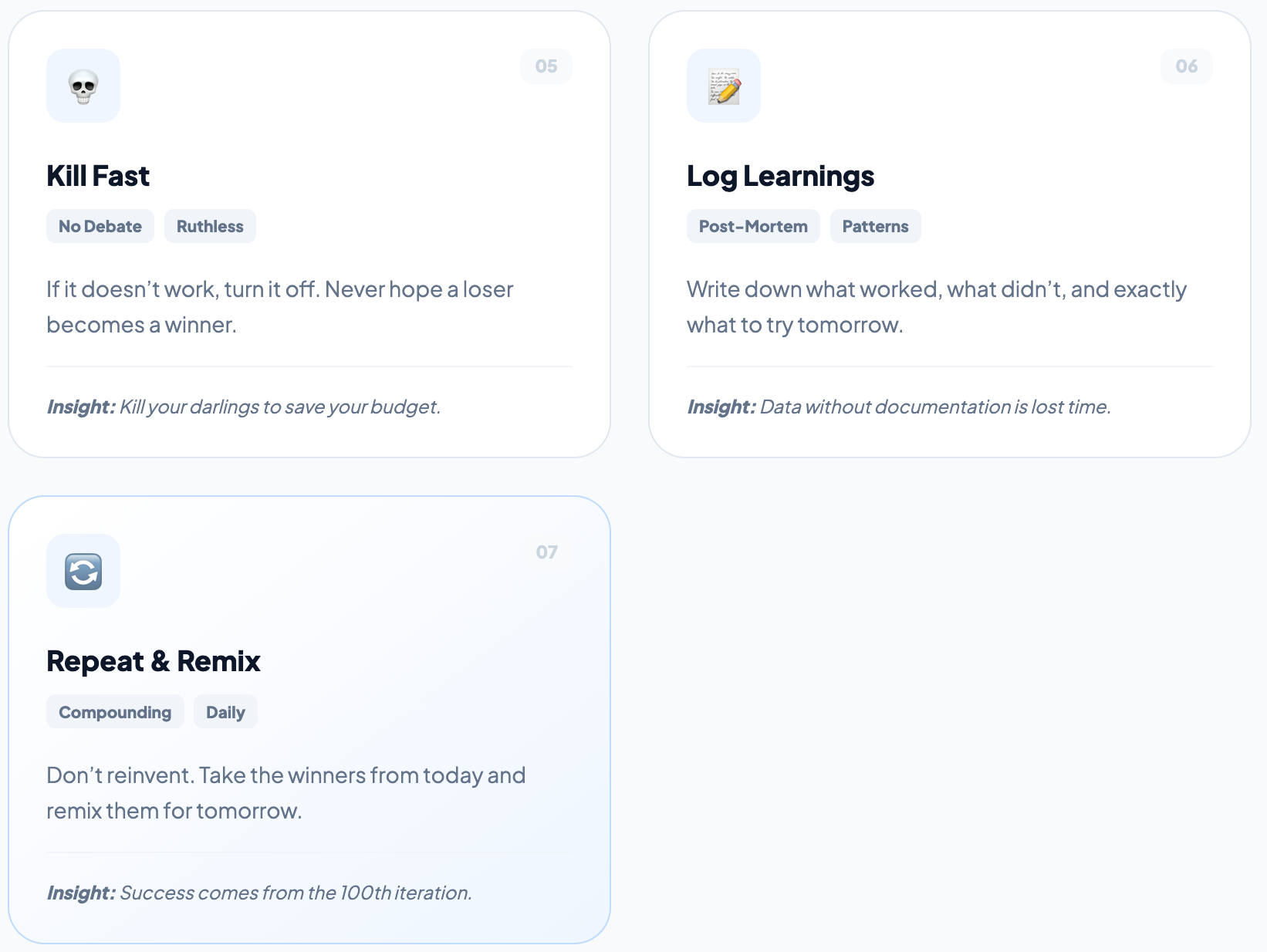
Attachment is what happens when you spend hours editing something and you start believing it deserves to work. So you keep it running longer than you should. You justify weak results. You defend the idea instead of improving it. And suddenly you’re optimizing around your ego, not the numbers.
Psychologically, this is basically the sunk cost effect, continuing something mainly because you’ve already invested time, money, or effort into it, even when it’s clearly not paying off. That pattern shows up everywhere, and it definitely shows up in ads.
The shift is simple, but it takes practice: care about the craft, detach from the outcome. You can put real love into an ad, and still be ready to kill it quickly if the market says no. That’s not cold. That’s professional. That’s how you protect budget, protect speed, and keep the loop moving toward the next winner.
The Daily Loop (Simple)
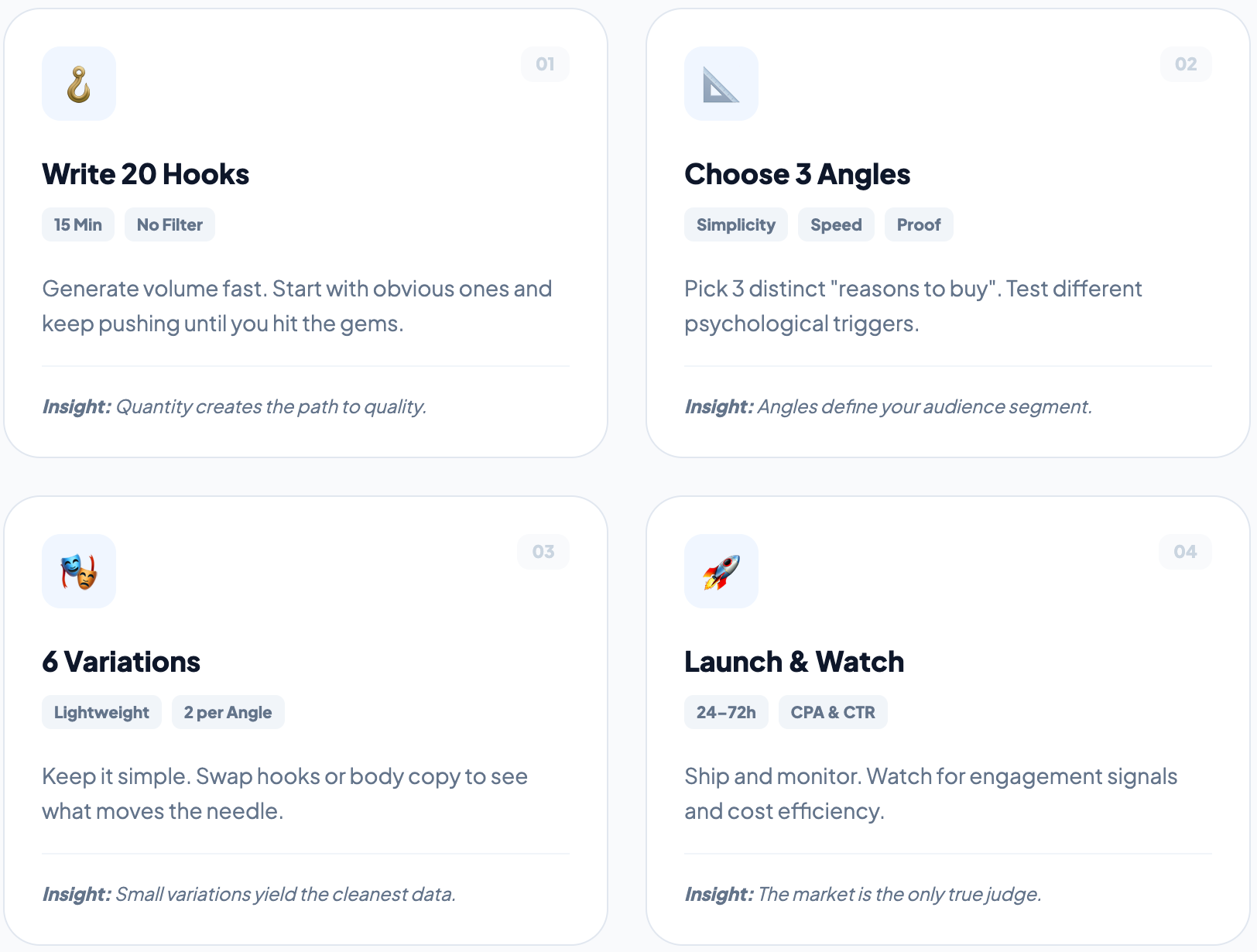
The fastest way to find winning ads isn’t to chase “one perfect concept.” It’s to run a repeatable loop every day, the same way Zach described it in the transcript: create, test, learn, and feed it back into the next round.
You start with hooks, and you bias for volume. Not because you want mediocre ideas, but because the first 5–10 are usually the obvious ones. The good stuff shows up after you’ve emptied the brain of the “safe” ideas. A simple rule that works in real teams: say the worst ideas out loud first. It lowers the pressure, removes the ego, and suddenly the room gets productive. Meta even encourages structured creative testing by comparing multiple variants, the point is to learn what performs, not to be precious about any single version.
Once you have a list of hooks, you pick a few angles on purpose. This is how you avoid falling in love with one “winner” and trying to force it forever. Same product, different reasons to care: speed, trust, simplicity, identity, proof. You’re basically asking: Why would this person buy? and giving yourself three different answers so you can test which motivation actually moves people.
Then you build variations quickly. This is where most people waste time: they overproduce too early. Instead, keep it lightweight at the start. Take one hook and write a few different bodies for it. Or keep the body and swap the hook. The goal is to isolate what’s working. If you treat each variation like a controlled experiment, you get clearer learnings faster, and that’s exactly how Google frames experimentation: define what you’re changing, track the impact, and use results to guide the next test.
After that, you launch and look for signal, not vibes. You’re not trying to “judge the ad,” you’re trying to spot early indicators that it’s earning attention and moving people forward. For video, Meta’s own definitions around video plays (like 3-second plays) help you measure whether the opening is stopping the scroll at all. From there you’re typically watching things like CTR and CPA direction in the first window, not as final truth, but as a “keep going vs cut fast” decision.
And finally, you log the learnings and repeat. This sounds boring, but it’s the part that creates compounding results. A simple note after each test is enough: what worked, what didn’t, what you’ll try next. Over time, that becomes your internal playbook, the exact opposite of random “creative inspiration” that resets to zero every week.
Hooks → angles → variations → launch → signal → notes → repeat.
Brainstorming When You’re Stuck
The hardest part about ads isn’t editing. It’s staring at a blank page and being expected to “be creative” on command.
In the transcript, they describe it perfectly: you sit in a two-hour meeting, you have to start from scratch, and somehow you’re supposed to walk out with a brand-new winning concept. But creativity doesn’t work like a light switch. So instead of waiting for inspiration, you give yourself a structure that forces momentum.
Start by dumping the bad ideas. Seriously. Say the obvious, the cringe, the lazy ones, all of them. This does two things: it removes pressure (because you’re no longer trying to sound smart), and it clears the mental clutter so the more interesting ideas can show up. Once the room is moving, you remix formats instead of inventing from zero. Look at what you’ve made before, what competitors are doing, or what patterns consistently work (reaction shots, “POV,” quick demos, confessions, myth-busting, comparisons). You’re not copying concepts, you’re borrowing structures that already hold attention.
And if you’re stuck because of visuals, simplify the idea rather than forcing an “epic” execution you can’t actually produce. They gave a great example: imagining a high-budget scene (a speeding car, dramatic cut-ins) and then realizing stock footage makes it look cheap, so the whole thing collapses. In that moment, the fix isn’t “try harder.” The fix is: choose an idea you can execute cleanly with what you have.
That’s why sometimes “cozy + real” beats “crazy hook.” One of the best-performing hooks they mentioned wasn’t the unhinged stunt, it was literally drinking coffee. Calm, normal, believable. In a loud, over-edited feed, “real life” can be the pattern interrupt. The goal isn’t to be the most dramatic. It’s to be the most watchable for the right audience.
What Actually Matters
A lot of people build their entire strategy around one goal: go viral. But virality is a terrible KPI if you care about revenue.
Views and likes are loud, visible, addictive metrics, and they can still mean nothing. You can get a spike of attention that brings the wrong audience, attracts “funny” comments, or entertains people who were never going to buy. Even worse, you can go viral for the wrong reasons and damage trust. The point isn’t to win the feed. It’s to move the right customer one step closer to saying yes.
That’s why UGC works so well when it’s done properly. Not because it’s trendy, but because it acts like proof. It shows the product in a normal environment, in normal hands, with normal expectations, the exact things modern buyers look for before they commit. TikTok itself has published research showing UGC-style content increases trust and can improve purchase intent because it feels more authentic than traditional brand ads.
And here’s the part most teams ignore: your creative output is only as good as your judgment, and your judgment gets worse when you’re burnt out.
When you’re fried, everything starts to look the same. You recycle safe ideas. You overthink hooks. You lose taste. That’s why breaks aren’t a reward, they’re part of performance. Even short resets can sharpen decision-making and reduce mental fatigue, which is directly tied to better creative work. The American Psychological Association has covered how breaks support performance and well-being, especially under sustained cognitive load.
So if you want a simple filter for what actually matters, it’s this:
Make ads that build trust, fit your buyer’s real journey, and keep you sharp enough to iterate. Virality is optional. Consistent wins aren’t.
Conclusion
Don’t aim for perfect ads. Perfect is slow, expensive, and usually imaginary anyway.
Aim for a repeatable loop: ship → test → learn → iterate. That’s where winning creative actually comes from. You put ideas into the market quickly, you listen to what the numbers (and the audience) are telling you, and you build the next version from real feedback, not guesses.
Detach from any single piece of creative. Stay committed to the process. Because in the long run, the loop beats the masterpiece every time.
Table of contents