

Scroll through social media and UGC looks almost effortless. Short videos, aesthetic setups, and bold income claims have created the impression that anyone can pick up a phone and start landing paid brand deals within weeks.
The reality is more nuanced.
Viral posts and “I made $10K in my first month” stories have quietly distorted expectations. Many new creators enter the UGC space believing the hardest part is simply filming content, when in fact the work behind the scenes, planning, revisions, client communication, and delivery, is what separates hobbyists from professionals.
This gap in expectations doesn’t only affect creators. Brands often misunderstand what quality UGC actually requires, expecting editorial-level output on a creator-level budget, or assuming volume alone guarantees performance.
In this guide, we’ll break down the biggest UGC myths, what actually happens behind the scenes, and what both creators and brands should understand in 2026.
Because succeeding in UGC isn’t about shortcuts, it’s about clarity, skill, and consistency.
Myth #1: “UGC Is Passive Income”
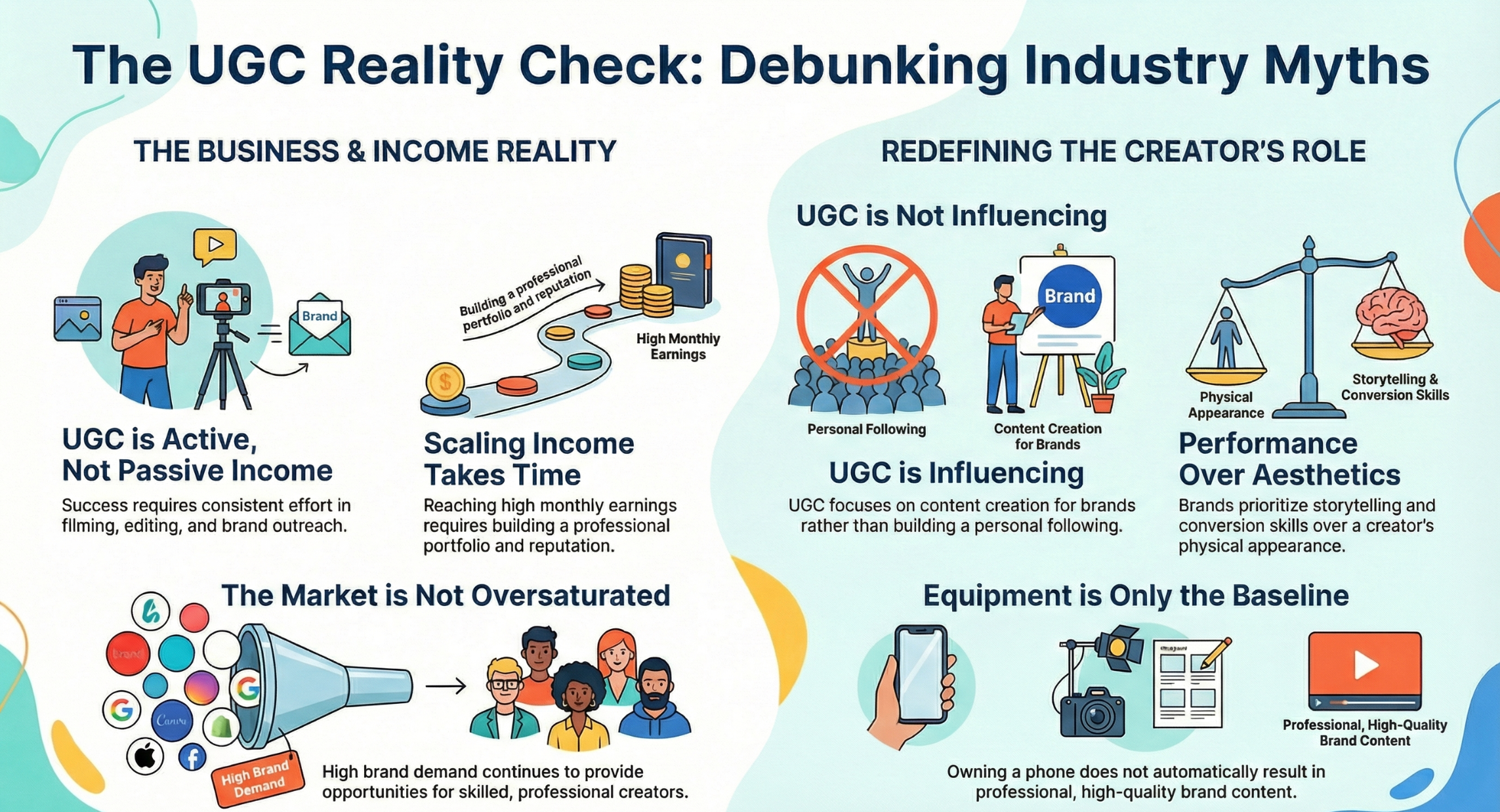
One of the biggest misconceptions in the creator economy is the idea that UGC is passive income. The narrative usually goes like this: record a few videos, send them to brands, and watch the money come in.
In reality, UGC is an active service business.
Behind every finished video sits a stack of work most beginners don’t see at first. There’s pre-production planning, scripting, filming, retakes, editing, formatting for different platforms, brand communication, revisions, file delivery, invoicing, and ongoing relationship management. Even small projects can involve multiple back-and-forth touchpoints with a client.
This hidden workload is exactly where many new creators get frustrated. They enter expecting lightweight content work and quickly realize they’re running a mini production studio combined with client service. When expectations don’t match reality, burnout and imposter syndrome tend to follow.
Creators who succeed long term understand this early. They don’t treat UGC like quick passive income, they treat it like a structured creative service with repeatable processes and clear client management.
Key takeaway: UGC is not passive, it’s content production plus client service.
Myth #2: “You’ll Make $5K/Month Fast”
This is one of the most damaging expectations new UGC creators walk in with.
Social media is full of highlight stories:
“I made $10k in my first month.”
“Quit my job in 90 days.”
“UGC changed my life overnight.”
What you don’t see is the messy middle.
In reality, most creators start with:
- lots of outreach
- gifting-only deals
- slow responses
- and long stretches with no paid collaborations
The early phase of UGC looks much more like pipeline building than instant income. You’re learning briefs, improving delivery, building a portfolio, and figuring out how brands actually buy.
When expectations are set by viral success stories instead of real timelines, frustration kicks in fast. That’s where imposter syndrome, burnout, and the comparison spiral usually begin.
Strong creators understand something important: UGC compounds. The first paid deals are the hardest. Once you build proof, systems, and repeat clients, growth becomes much more predictable.
Key takeaway: UGC income usually builds gradually, not overnight.
Myth #3: “The UGC Market Is Oversaturated”
It’s true that more people than ever are trying UGC. Scroll any creator community and you’ll see the same pattern: new portfolios every day, new creators announcing their services, and plenty of noise across platforms.
But volume doesn’t equal saturation.
What brands actually experience is very different from what creators assume. Yes, there are many beginners entering the space, but far fewer creators consistently deliver ad-ready, performance-focused content. Brands aren’t just looking for someone who can film a nice video. They’re looking for creators who understand hooks, pacing, messaging, and how content performs in paid environments.
This is where the real gap appears.
Many portfolios look good on the surface but fall short when brands ask practical questions:
- Can this run as a paid ad?
- Does the hook stop the scroll?
- Is the messaging clear and conversion-focused?
- Can this creator deliver consistently and on brief?
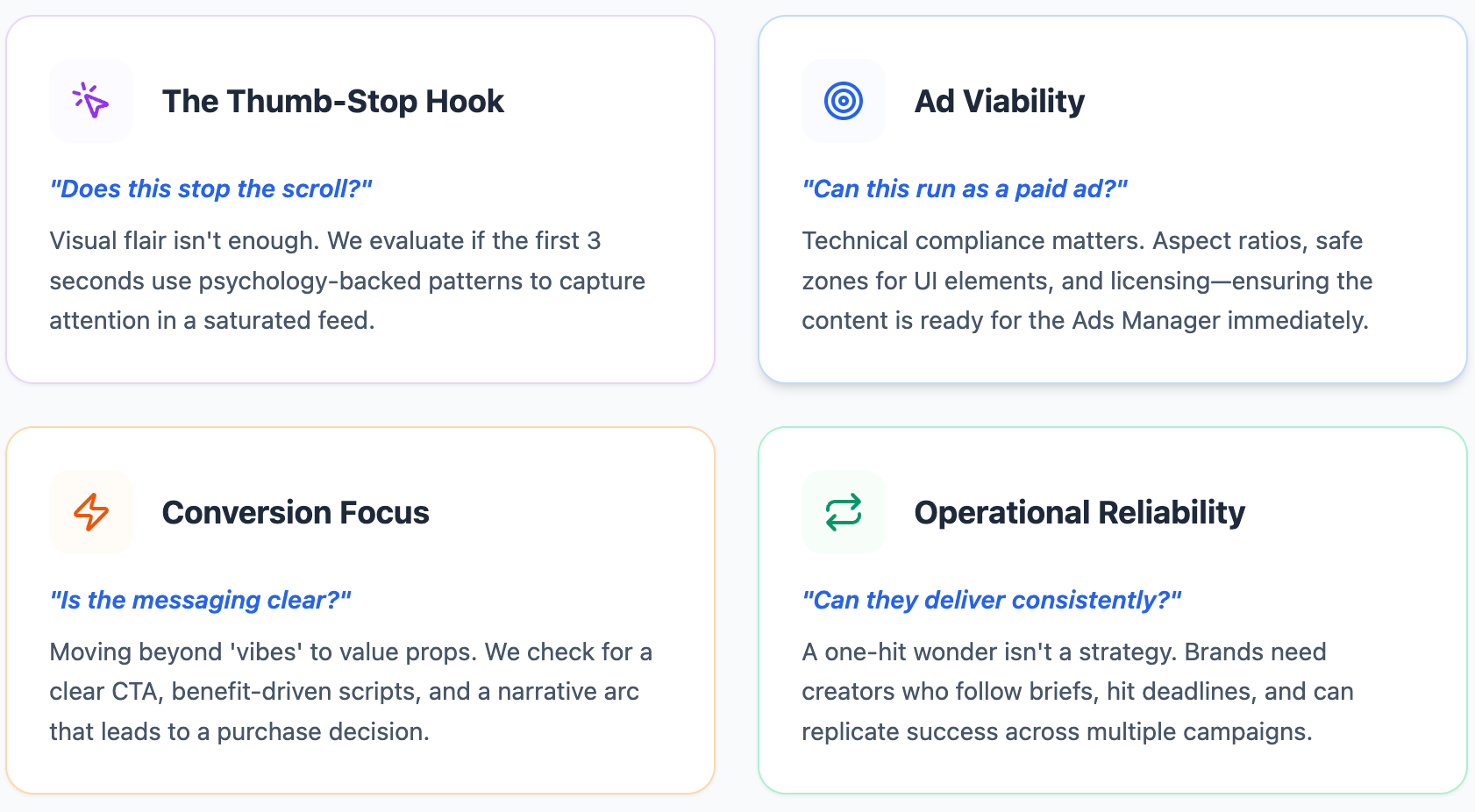
From the brand side, finding creators who check all those boxes is still surprisingly difficult in 2026.
The result? The entry level feels crowded, but the professional tier remains undersupplied.
Creators who invest in storytelling, performance thinking, and reliability quickly separate themselves from the noise. The opportunity hasn’t disappeared, the bar has simply moved higher.
Key line: The market is noisy, but high-quality creators are still in demand.
Myth #4: “If You Have a Phone, You Can Do High-Quality UGC”
Smartphones have lowered the barrier to entry, but they haven’t lowered the bar for performance.
Yes, technically anyone can record a clean-looking video today. Cameras are better, apps are easier, and editing tools are everywhere. But brands aren’t paying for footage. They’re paying for ad-ready content that drives results.
And that’s where many beginners hit a wall.
There’s a big difference between simply recording a video and delivering something a brand can confidently run as an ad. The second requires a completely different skill set, one that goes far beyond pressing record.
Strong UGC creators understand structure. They know how to open with a hook, build curiosity, and guide the viewer toward a clear outcome. They understand messaging, what to say, what to cut, and how to make the value of a product instantly obvious.
Performance also matters more than most people expect. Natural delivery, pacing, tone, and on-camera confidence all influence whether a video feels trustworthy or skippable.
Then comes editing judgment. Not flashy edits, smart ones. Knowing when to cut, when to zoom, when to add captions, and when to keep things simple is what makes content feel native to the platform and ready for paid use.
Finally, consistency separates hobbyists from professionals. Brands don’t just want one good video. They want creators who can deliver quality repeatedly, on brief and on time.
Punch line: High-quality video does not automatically mean high-quality UGC.
Myth #5: “Looks Are What Get Creators Hired”
This belief quietly damages a lot of good creators before they even get momentum.
When people assume UGC success is mostly about appearance, two things happen. First, talented creators hesitate to start because they think they don’t “look the part.” Second, creators who do start often focus on aesthetics instead of performance, which is what brands actually care about.
From the brand side, the optimization goal is much more practical. Brands are asking:
- Does this person communicate clearly?
- Does the content feel believable?
- Would this work as an ad?
- Can this creator drive action?
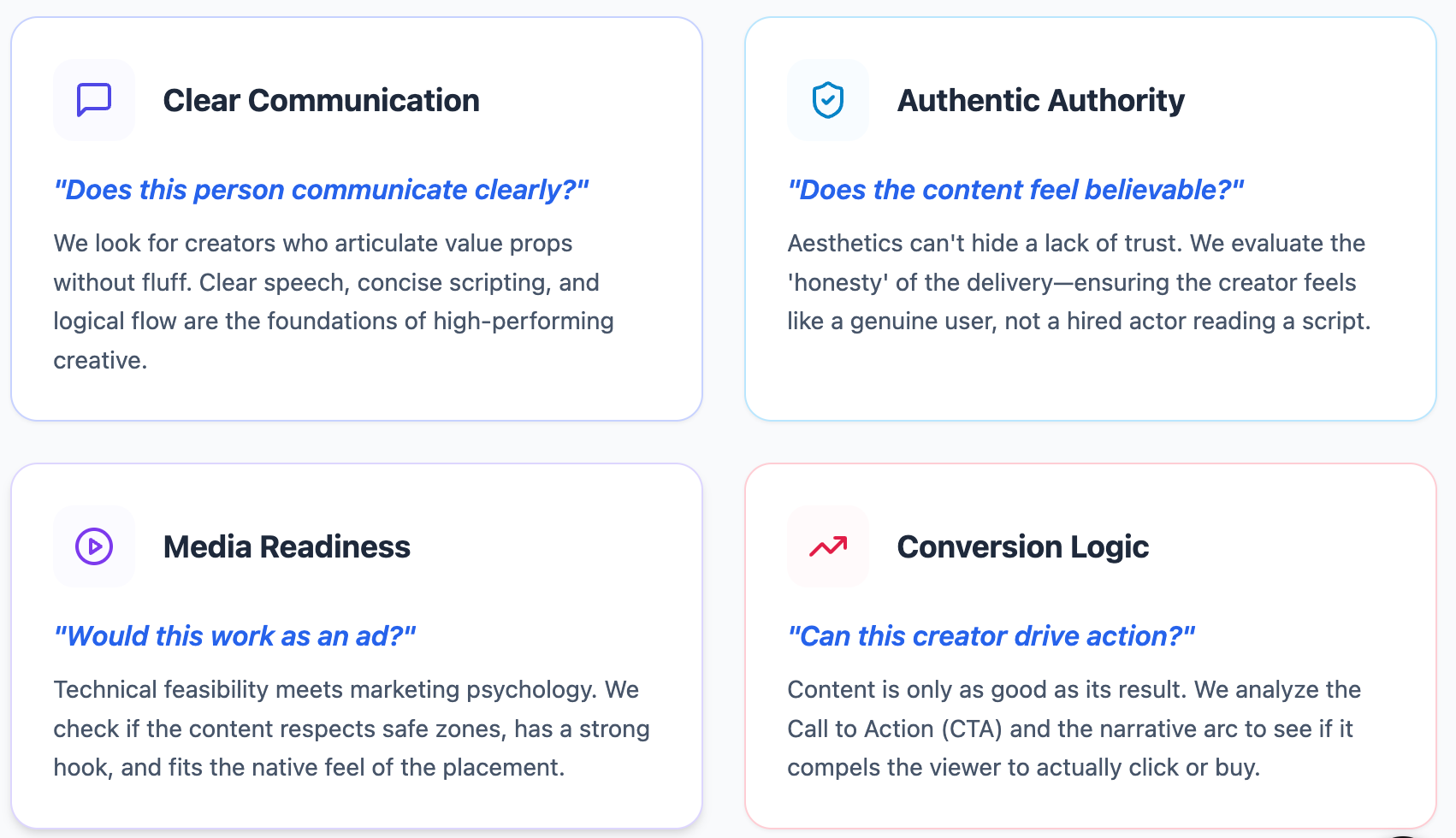
In most UGC campaigns, relatability beats perfection. Content that feels too polished, too model-like, or too “ad-looking” can actually reduce trust and scroll-stopping power. That’s why many high-performing UGC ads look natural, simple, and human.
UGC was never meant to feel like a luxury studio shoot. It’s meant to feel like a real person sharing a real experience in a way that converts.
Creators who win long term usually focus on:
- clear delivery
- strong hooks
- confident presence
- and consistent execution
not chasing a specific look.
Key takeaway: In UGC, performance and clarity beat appearance long term.
Myth #6: “UGC and Influencing Are the Same Thing”
This confusion still causes friction between creators and brands in 2026.
On the surface, UGC and influencer content can look similar, both involve creators making videos for brands. But the business model, expectations, and success metrics are very different.
UGC is ad-focused. Brands hire UGC creators to produce content they can use in paid ads, landing pages, and funnels. The content is usually brand-owned, and performance is measured by metrics like click-through rate, conversions, and hook strength. The creator’s follower count often doesn’t matter at all.
Influencer marketing works differently. Influencer content is audience-based and reach-driven. Brands are paying for access to the creator’s existing community and distribution power. The value comes from visibility, trust with followers, and organic reach on the creator’s personal platform.
Because of this difference, the skill sets only partially overlap. A great influencer isn’t automatically a great UGC creator, and vice versa. UGC requires strong ad instincts, structured messaging, and conversion-focused delivery, while influencer campaigns prioritize audience fit and reach.
When creators mix these two models, expectations break. They may focus too much on growing followers instead of improving ad performance skills, or misunderstand why brands care more about execution than audience size.
Key insight: UGC is a service business, not a popularity contest.
Myth #7: “Editorial Ads Count as UGC”
This is one of the biggest misunderstandings between brands and creators, and it quietly breaks a lot of collaborations.
At its core, UGC and editorial ads serve different purposes and require very different production setups.
UGC is meant to feel real, creator-led, and naturally integrated into everyday environments. Most high-performing UGC is filmed at home, in simple settings, with minimal gear. The strength of UGC comes from authenticity, relatability, and speed of production, not cinematic polish.
Editorial ads, on the other hand, are high-production campaigns. They often involve multiple locations, professional lighting, crews, actors, and detailed shot planning. The goal is brand polish and visual impact, not necessarily native social performance.
The tension happens when brands expect editorial-level output… but brief it as UGC.
Creators then receive requests like:
- film in a busy café
- shoot in a cinema
- create multi-scene lifestyle moments
- stage complex outdoor shots
At that point, the project has already crossed into production territory, even if the budget hasn’t.
This mismatch creates frustration on both sides. Brands feel the content isn’t “premium enough,” while creators are being asked to deliver production-level work with creator-level resources.
Clear expectations fix most of this.
UGC works best when brands lean into what makes it powerful: speed, authenticity, and ad-native storytelling. Editorial works best when the goal is brand polish and controlled visuals.
Memorable line:
If the brief needs a cinema, that’s not UGC, that’s a shoot.
Myth #8: “Every Brand Inbound Is a Real Opportunity”
As UGC grows, so does the number of inbound messages creators receive, and unfortunately, so do the scams.
Many beginners assume that every brand email or DM is a genuine opportunity. In reality, some of the most convincing scams today look almost identical to real collaborations. They use polished websites, professional language, and even impersonate well-known brands.
The goal is simple: create urgency and get the creator to spend money or share sensitive information.
One of the most common traps is the “buy first” collaboration. The brand offers a paid partnership but asks you to purchase the product upfront with the promise of reimbursement later. In most cases, that payment never comes.
Other red flags include slightly misspelled domains, generic email addresses, rushed timelines, or messages that feel oddly scripted. Even legitimate-looking outreach can be fake if the sender details don’t fully match the brand’s official channels.
Creators who last in this space develop one key habit: healthy skepticism.
Rule to remember:
If it feels fishy for a second, it probably is.
Before moving forward with any collaboration, do a quick verification pass:
- Check the sender’s email domain carefully
- Look up the brand’s official website and contact pages
- Search for previous creator collaborations
- Be cautious of any request to purchase products upfront
- Trust your gut if something feels off
You don’t need to be paranoid, just professional and alert.
The creators who build long-term UGC careers aren’t just good on camera. They’re also careful operators who protect their time, money, and reputation.
What High-Performing UGC Creators Do Differently
By now, the pattern is clear. The creators who consistently get booked, and rebooked, aren’t relying on luck, aesthetics, or viral moments. They treat UGC like what it actually is: a service business that rewards consistency and professionalism.
High-performing creators approach their work with intention. They understand that brands aren’t just buying footage, they’re buying reliability, clarity, and performance. That mindset alone separates hobbyists from creators who build real income streams.
First, they treat UGC like a business. That means structured workflows, clear pricing, defined turnaround times, and professional communication. They don’t “wing it” from brief to brief.
Second, they focus obsessively on ad-ready skills. Instead of just filming nice-looking clips, they study hooks, pacing, messaging, and conversion psychology. Their content answers the question every brand is silently asking: Will this sell?
They also build repeatable systems. From briefing templates to filming setups and editing workflows, strong creators reduce friction in their process. This allows them to deliver consistently without burning out every time a new project comes in.
Client communication is another quiet differentiator. The best creators reply quickly, confirm details early, handle feedback calmly, and make the brand feel safe working with them again. In many cases, this matters as much as the footage itself.
Finally, they protect their time and energy. They vet opportunities, avoid obvious scams, and don’t chase every inbound message. Focus beats volume.
Final Thoughts: Reset Your UGC Expectations
UGC is still one of the biggest opportunities in the creator economy right now. Brands need authentic, ad-ready content at scale, and the demand isn’t slowing down anytime soon.
But the winners in this space won’t be the ones chasing shortcuts or believing the hype. UGC rewards creators who treat it like a real business, with clear processes, strong fundamentals, and consistent execution. It also rewards brands that understand what they’re actually buying and set realistic expectations from the start.
When both sides approach UGC professionally, the results compound: better content, smoother collaborations, and more repeat deals.
The creators who win in 2026 won’t be the loudest, they’ll be the most reliable.
Table of contents
- Myth #1: “UGC Is Passive Income”
- Myth #2: “You’ll Make $5K/Month Fast”
- Myth #3: “The UGC Market Is Oversaturated”
- Myth #4: “If You Have a Phone, You Can Do High-Quality UGC”
- Myth #5: “Looks Are What Get Creators Hired”
- Myth #6: “UGC and Influencing Are the Same Thing”
- Myth #7: “Editorial Ads Count as UGC”
- Myth #8: “Every Brand Inbound Is a Real Opportunity”
- What High-Performing UGC Creators Do Differently
- Final Thoughts: Reset Your UGC Expectations
Table of contents
- Myth #1: “UGC Is Passive Income”
- Myth #2: “You’ll Make $5K/Month Fast”
- Myth #3: “The UGC Market Is Oversaturated”
- Myth #4: “If You Have a Phone, You Can Do High-Quality UGC”
- Myth #5: “Looks Are What Get Creators Hired”
- Myth #6: “UGC and Influencing Are the Same Thing”
- Myth #7: “Editorial Ads Count as UGC”
- Myth #8: “Every Brand Inbound Is a Real Opportunity”
- What High-Performing UGC Creators Do Differently
- Final Thoughts: Reset Your UGC Expectations